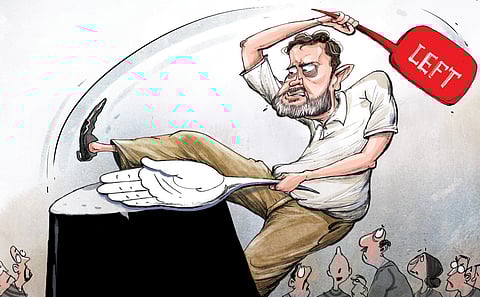

The term ‘ideology’ has made a comeback to dominate the Indian public and political landscape in the last few years. It had become somewhat less fashionable since the early 1990s, but had a faint revival in 2014, when the Bharatiya Janata Party came to power. It found greater traction and mobility ever since the BJP sealed its dominance in 2019.
If ideology, as a somewhat rigid set or system of ideas, has seen a resurrection in more recent years, it can be argued that the reason is not the BJP, but the Congress. Since the Congress, under the leadership of Rahul Gandhi, began to perceive the BJP more as an intransigent ideological machine and less as a political opposition, it too began to devise a stubborn ideological response at the opposite end of the spectrum. From being a party with definite ideas and principles, it began to fancy being ideological.
This response pattern has been a kind of global playbook, and therefore Rahul Gandhi definitely came before Zohran Mamdani; but, for distinct reasons, their levels of success have varied. Anyway, this ideological game witnessed a new flashpoint in the last few days.
First, Priyank Kharge, son of Congress President Mallikarjun Kharge and a minister in Karnataka, wrote a letter to his own government demanding that the RSS’s activities in public places and government premises be regulated, if not banned. Next, Kharge Senior took the idea to Delhi. On October 31, he asked for banning the RSS.
The Congress seems to believe that to debilitate the RSS, often described as the ideological parent or mentor of the BJP, is to checkmate the saffron party. It may never have such a clear and straight outcome, but it is an assumption not without some logical basis. Interestingly, when Mallikarjun Kharge said he would prefer the RSS to be banned, he clarified that it was his “personal view”. Kharge Senior may have appeared diffident and treaded cautiously, but the idea had become the party’s mainstream opinion before he became the party’s president.
Rahul Gandhi’s blunt assertions on the RSS and its mentors have often got him into legal trouble. In May 2022, he had said, “My fight is with the ideology of the RSS and BJP, which is a threat to our country. I fight against the hatred and violence these people spread.” Again, in January 2023, he said he would never enter an RSS office, “I’ll have to be beheaded before that. My family has an ideology.”
In Karnataka, this ideological battle finds new expression every now and then. In the latest round, the Congress government is allegedly allocating government land at subsidised prices to the Congress Bhavan Trust across the state in over a hundred places. When the BJP was in power in the state, it had allocated large tracts for its own party offices and to RSS’s affiliate and sympathetic organisations. Now the Congress is doing something similar as an apparent ideological counter, although legally it may be in troubled waters.
Interestingly, the Congress did not cancel the land allocation the BJP had made to itself and its affiliates; on the contrary, it made it an ideological raison d’être to allocate itself more land. This has been revealed in detail by The File, a site that uses RTI as its primary investigative tool.
Despite such ideological battles that the Congress endeavours to construct across the nation, ironically, the RSS and BJP have always visualised their mission as cultural and civilisational. They do not use the registers that overtly communicate an ideological strife. It is always about cultural and civilisational recovery, restoration and rebuilding; about setting right historical injustices, imagined or real.
When the Congress gets ideological, when it operates at the extremes of what it assumes to be progressive politics, then its liberal claims get dented. Any firm ideological position acquires a certain blindness, militant idiom, and exclusivity. It begins to rapidly judge even reasonable and rational concessions to the other. It begins to brand and shame those who are non-aligned. Therefore, the casualty of the Congress’s ideological nature could be the near-decimation of a moderate, a centrist, and even a classic liberal. This again has become a global feature.
Studies have shown that the ideological divide in the US has become more consolidated since 2008, while the gradual disappearance of moderates in Republican and Democratic parties happened between 1976 and 2008. The rise of Zohran Mamdani as New York’s mayor-elect may force the Democrats to move deeper leftwards from the centre. There is an enormous difference between the Bernie Sanders kind of socialism and the one espoused by Mamdani, who is more cultural.
In India, too, Rahul Gandhi has tried to mix socialist economic ideas with caste identity politics, but has not been effective for a variety of reasons. People do not see the Congress as loony ideological, but as an inheritor of a certain kind of conservative centrism. But Rahul has even used a liberal Constitution as an ideological wand to be waved.
One wonders why the Congress, which has taken interest lately in constitutional icon B R Ambedkar, has not paid sufficient attention to his ideas of pragmatism. Ambedkar, according to his biographer Ashok Gopal, did not believe in the “finality of thinking” or “ultimate truth”, but argued that “in political negotiations the rule must be what is possible”. Ambedkar did not want a compromise on principles, but said once the principle was agreed upon, “there can be no objection to realising it in installments”. Ambedkar felt that such graduation in politics was inevitable, and in some circumstances advantageous. The Congress’s ideological hardening does not accommodate this nuance, but attempts an instant revolutionary flavour.
British writer and academic Raymond Willams wrote that the term ‘ideology’ was used in a pejorative sense first by Napoleon, as a kind of “abstract, impractical and fanatical theory” to characterise the French revolution. That characterisation has remained in popular argument. Marx and Engels, too, used it to mean ‘illusion’, ‘unreality’ and ‘false consciousness’ in some of their writings. Willams also pointed out the distinction that has historically been made between ‘ideology’ and ‘science’.
In this light, the Congress party may benefit from deliberating how much ideological positioning is good for it, and how much to embrace pragmatism and principles.
Sugata Srinivasaraju | Senior journalist and author of The Conscience Network: A Chronicle of Resistance to a Dictatorship
(Views are personal)
(sugatasriraju@gmail.com)