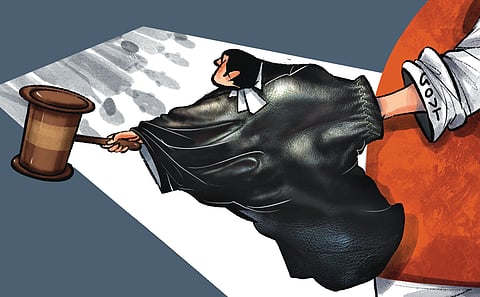

The surest way to throttle democracy is to weaponise laws and target those opposing the government. This government seems to have converted this into an art.
I recall the day the amendment to the Unlawful Activities (Prevention) Act, 1967 (UAPA), was taken up for discussion in Parliament. The Home Minister openly stated that this was necessary, for none could oppose the inclusion of terrorists and terrorist organisations in the First Schedule of the UAPA, seeking to destabilise our Republic. I intervened and expressed my fears that these laws are likely to be used against our citizens; it has turned out to be a reality.
The prosecution of young students, like Umar Khalid and Sharjeel Imam, under those laws has resulted in them languishing in jail for years without a trial. Such laws have been used against journalists, academics, and members of religious communities in this country. The obvious intent was to silence them.
The weaponisation of the Prevention of Money Laundering Act, 2002 (PMLA) is evident in its widespread use against political opponents, including chief ministers and ministers from opposition-ruled states, such as Arvind Kejriwal, Manish Sisodia, Satyendra Jain, Hemant Soren, and Farooq Abdullah, among others. Valiant attempts were made to move against Siddaramaiah, but they came to nought. These laws have also been used to instil fear in several leaders who were once part of the opposition but have been persuaded to join the BJP to save themselves from prosecution and imprisonment.
The BJP has, particularly in Maharashtra, rewarded opposition leaders against whom serious allegations of corruption were publicly made for causing a split in their erstwhile parties. They are now part of the coalition ruling Maharashtra.
The latest example of weaponisation of laws is the introduction of two Constitution (Amendment) Bills in Parliament on August 20, 2025. It is claimed that this is being done in public interest, for the welfare of the people and to uphold the principles of constitutional morality, and good governance—concepts that are alien to the functioning of this government.
What is likely to serve is not public interest, but the political interest of the ruling dispensation. This is clear from the fact that the proposed law provides that the chief ministers and ministers being investigated for offences punishable for more than five years and being in custody for more than 30 days will, on the 31st day, if they have not resigned, be dismissed by the governor of the state.
The principle of law that our Republic has embraced is that a person is innocent till proven guilty. In this case, a minister or a chief minister can be removed on a mere allegation without any proof. We are all aware that many such cases have been pending trial for over a decade and that the conviction rate in several of these prosecutions is abysmally low.
If the proposed constitutional amendments become law, it is most likely that trumped-up allegations will be made to target sitting chief ministers and ministers, and after 30 days in custody, they will be dismissed from those positions. Such allegations in the past have served the political interests of the BJP. The present establishment seeks to utilise these laws for its own political purposes.
This weaponisation is also evident from how laws such as PMLA or UAPA have been used against influential ministers seeking to coerce them to join the BJP, or even public servants not belonging to any political party, in opposition-ruled states.
Ironically, since 2014, these laws have never been invoked against any minister in any of the BJP-ruled states, or, for that matter, against any minister within the ruling establishment at the Centre. Obviously, the selective use of such laws serves the political interest of the party in power.
The other matter of great concern is that such laws will allow the governor to dismiss a chief minister or a minister of the opposition-ruled state, which, under the present legal framework, can happen only upon conviction.
In addition, prosecution against public servants holding such positions can only be launched by seeking the sanction of the Council of Ministers in the case of prosecution against a minister and that of the governor in the case of a chief minister. By seeking to do away with the sanction provision, such laws weaponise the governors appointed by the Union to dismiss a minister or a chief minister. This is a direct invasion of the federal structure of this country, which the Supreme Court has held to be one of the basic features of the Constitution.
Having set out the above, it is also significant that these constitutional amendments have been introduced by the present establishment, aware that such Bills cannot become law without garnering the support of a two-thirds majority in both the Lok Sabha and the Rajya Sabha.
The NDA, at present, consists of 293 members of the Lok Sabha, whereas for such Bills to pass muster, it must receive the support of 363 members. This is obviously a tall order, and these Bills, in all likelihood, will fail.
If they become law, they will surely be challenged in the courts. The courts will not favour such attempts to deface the Constitution. On the face of it, these Bills are manifestly unjust, violate the fundamental tenets of federalism and the basic principles of the rule of law.
One wonders why these Bills were introduced in the first place. There may be two reasons. One, the canard that the government wishes to rid the polity of criminals who are being prosecuted and that the opposition does not want to uphold the principles of constitutional morality—a political narrative, which in the context of how this government has jettisoned these principles, will not find favour with the people. Perhaps the other and real reason is to divert the attention of the people of India from the massive show of public support for opposition leaders in the run-up to the assembly elections in Bihar.
It appears constitutional democracy can be throttled and stymied through the weaponisation of laws. A new form of dictatorship!
Kapil Sibal | Senior lawyer and member of Rajya Sabha
(Views are personal)
(Tweets @KapilSibal)